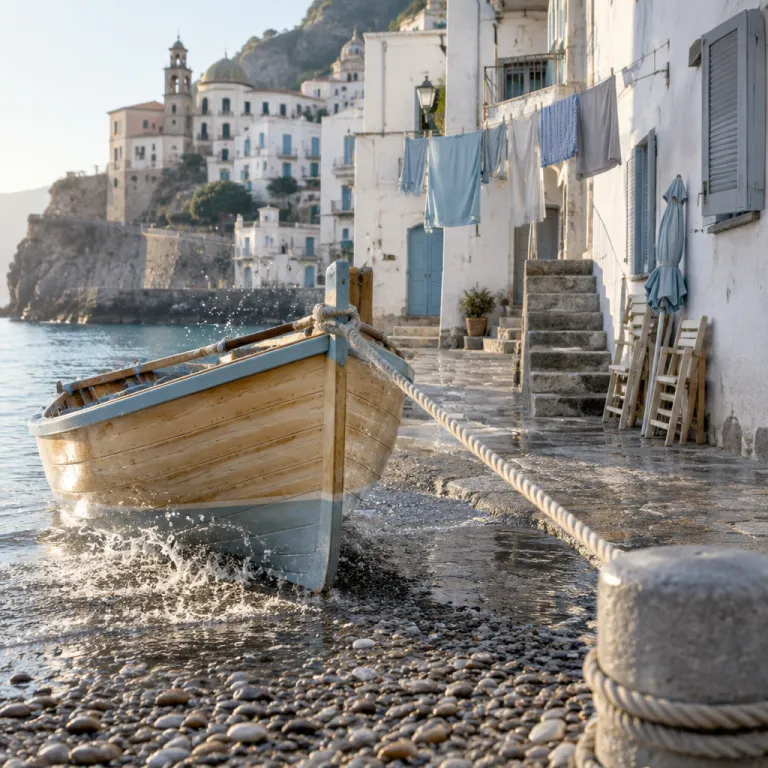
Atrani on the Amalfi Coast: a small Italian town with a separate world feel
Why Atrani on the Amalfi Coast feels like a separate world
Atrani on the Amalfi Coast sits in a narrow cleft of rock between mountain and sea. The village is technically attached to Amalfi town by a short coastal walk, yet it feels like a self-contained world shaped by centuries of ritual. Here the scale is intimate, the pace unhurried, and the rhythm of the day still follows church bells and the shoreline.
This is officially the smallest town in Italy, with an area of about 0.1206 km² and a population of roughly 855 residents, according to municipal and regional data from the Comune di Atrani and Campania authorities.1 Yet its history is outsized because Atrani was once the political heart of the medieval Duchy of Amalfi. When you stand between the arches of the church of San Salvatore de’ Birecto and look up toward the ruins of the Torre dello Ziro, you are in the former ceremonial core of a maritime republic that traded across the Mediterranean. That legacy still shapes how locals see Atrani today, and why they quietly protect it from the mass tourism that has transformed much of the Amalfi Coast, now recognised as a UNESCO World Heritage cultural landscape.2
Geographically, Atrani is wedged between the sea and the steep slopes that rise toward the watchtower of the Torre dello Ziro, with the main street and the riverbed road funnelling everything into a single piazza. The official border with Amalfi town is barely noticeable, yet the moment you leave the traffic of the coast road and step under the low vaults toward Piazza Umberto I, the mood shifts. You are no longer in a transit corridor along the Italian shoreline, but in a lived-in village where the sea, the church, and the piazza still hold equal weight.

The piazza rhythm: living with Atrani as your base
Piazza Umberto I is the only real civic stage in Atrani, and it carries the entire day’s performance. In the early morning, when the light is soft and the sea is still, residents cross the square for coffee while children cut through on their walk to school in Amalfi. You sit under the arches with an espresso, watching the view of Atrani slowly brighten as the sun clears the ridge above the church of Santa Maria Maddalena.
By afternoon the square empties, the spiaggia Atrani and the small curve of Atrani beach taking over as the social centre for a few quiet hours. The sand is modest by Amalfi Coast standards, yet the proximity to the town and the shelter of the cliffs make this beach feel like a private cove, especially compared with the busier stretches near Salerno or the larger beaches along the coast. Families move between the water and the shade of the piazza, and the main street that threads through the vaults behind you feels more like a corridor of domestic life than a commercial strip.
Evenings are when the full character of Atrani emerges, with the church of Santa Maria Maddalena dei Pazzi lit above the town and the sound of cutlery from three or four trattorie around Piazza Umberto. This is not a place of Michelin stars or showpiece dining rooms; it is a place where the menu follows the fisherman’s morning and the vegetables from the terraces above the Torre dello Ziro. If you are used to the polished clifftop hospitality of larger Amalfi Coast resorts, whose place-driven programs pull guests off the road and into local life, Atrani offers the same connection to the shoreline but through a village-scale lens.

Churches, alleys and the vertical geography of Atrani
The geography of Atrani is vertical, and you feel it in your legs before you see it on a map. From the sea-level curve of spiaggia Atrani, stairways climb in tight zigzags toward the church of Santa Maria Maddalena, whose white façade and baroque bell tower anchor almost every view of the town. Higher still, paths lead toward the Torre dello Ziro, the ruined watchtower that once guarded the Duchy of Amalfi and now offers a panoramic view of Atrani and the wider Amalfi Coast.
At the base of the village, almost at the level of the main street and the riverbed, stands the church of San Salvatore de’ Birecto, once the coronation site for the leaders of the Duchy of Amalfi. Its simple façade hides a layered history that connects this tiny town to the wider story of Campania and the maritime republics of the Mediterranean. Between these two churches, Santa Maria Maddalena above and San Salvatore below, the alleys of Atrani twist in a dense weave of archways, staircases, and vaulted passages that keep the streets cool even on the hottest day.
Walking these alleys is the best way to understand why Atrani on the Amalfi Coast feels distinct from the more performative glamour of other places along this part of Italy. You pass shrines to the Virgin Mary and local saints, laundry lines strung across the narrowest lanes, and tiny corners where the view suddenly opens to the sea. For travellers who appreciate the clifftop silence of villages like Ravello, whose quiet pull on serious travel is well documented, Atrani offers a more maritime version of that same authenticity, pressed tightly between mountain and water.

Where to stay: luxury in Atrani means proximity, not pomp
Luxury in Atrani is not about a grand lobby or a long list of amenities. It is about waking up within a two-minute walk of both the sea and Piazza Umberto I, hearing the church bells of Santa Maria Maddalena and San Salvatore mark the day, and being able to cross the entire town in less than five minutes. Properties here are small, often family-run, and they lean into the geography rather than fight it.
Rooms carved into the cliff face may offer a framed view of Atrani beach, the curve of spiaggia Atrani, or the open sea beyond the breakwater, with balconies just large enough for two chairs and a lemon tree. You trade the anonymity of a large resort on the wider Amalfi Coast for the intimacy of a place where the owner knows which day you plan to travel to Amalfi town or Salerno, and will time breakfast so you can walk to the bus without rushing. For many solo explorers, that level of attention feels more luxurious than any spa circuit.
Using Atrani as a base also gives you strategic access to the rest of the Amalfi Coast without surrendering your evenings to crowds. You can spend the day in the busy corridors of traffic around Amalfi and then retreat through the tunnel to a town that still runs on local time, or head inland to explore the hills above the former duchy and the paths toward the Torre dello Ziro. When you want a change of scene, you can look north to the cultural pull of larger Italian cities, using guides to elegant stays and events in urban hotels as a counterpoint to your seaside retreat.
How to visit Atrani respectfully: a day by the sea without leaving a mark
Spending a day in Atrani on the Amalfi Coast is less about ticking off sights and more about fitting into an existing rhythm. Start early, when the main street is still quiet, and walk under the arches into Piazza Umberto I for coffee while the town wakes around you. From there, a short stroll of about five minutes brings you to Atrani beach, where the sea is close enough to hear from the church steps.
Late morning is ideal for climbing toward the church of Santa Maria Maddalena, taking time to pause at each small terrace where the view of Atrani and the wider coastline opens up. Respect the fact that these stairways are not just scenic routes but daily paths for residents moving between home, work, and the sea. If you continue higher toward the Torre dello Ziro, stay on marked paths and remember that the terraces you pass are working landscapes, not open viewpoints.
Afternoons are best spent back at spiaggia Atrani or in the shade of the piazza, where you can watch the town’s life unfold without turning it into a backdrop. Choose one of the local trattorie for a simple dinner, letting the day’s catch and seasonal vegetables guide your order rather than a checklist of famous dishes. As one reliable summary from municipal and tourism sources puts it, “Atrani is known for being the smallest town in Italy and its preserved medieval architecture.”3
FAQ
Is Atrani a good base for exploring the Amalfi Coast ?
Atrani is an excellent base if you value authenticity over spectacle, because the town sits within walking distance of Amalfi yet remains far quieter in the evenings. You can travel easily along the Amalfi Coast to larger places such as Amalfi, Salerno, or Positano, then return to a village where the sea, the church, and the piazza still set the pace. For solo travellers, the compact scale and clear main street make it especially easy to navigate.
How do I reach Atrani from Amalfi or Salerno ?
Atrani lies directly on the coastal road that links Amalfi and Salerno, and the distance from Amalfi town is short enough for a pleasant walk through the tunnel or along the sea, usually around 10–15 minutes on foot. Buses running along the Amalfi Coast usually stop in or near Atrani, and taxis can cover the short hop from Amalfi in a few minutes. If you are driving, be prepared for limited parking and narrow streets typical of this stretch of southern Italy, and consider using paid garages on the edge of town when available.
What are the main sights in Atrani ?
The key places to visit include the church of San Salvatore de’ Birecto near the main street, the baroque church of Santa Maria Maddalena above the town, and the small curve of spiaggia Atrani at the water’s edge. Many visitors also hike toward the Torre dello Ziro for a wide view of Atrani and the surrounding Amalfi Coast. The real attraction, though, is the dense network of alleys and stairways that reveal the town’s preserved medieval character.
When is the best time to visit Atrani ?
The most comfortable periods for a stay or a day trip are between March and July, and from September to November, when temperatures are mild and the sea is still inviting. During these months, the town feels lived in rather than overwhelmed, and you can enjoy Atrani beach and the piazza without heavy crowds. High summer brings more visitors along the coast, but Atrani generally remains calmer than larger resorts.
What kind of accommodation can I expect in Atrani ?
Accommodation in Atrani tends to be small scale, with family-run properties carved into the cliff and guesthouses close to Piazza Umberto I and the sea. You will not find large five-star complexes, but you will find rooms with intimate views of Atrani beach, the churches, and the surrounding coastline. For travellers who appreciate character, proximity, and a strong sense of place, that trade-off feels like an upgrade.
References
1 Comune di Atrani municipal information; regional tourism data from Campania authorities for area, population and “smallest town in Italy” status.
2 Amalfi Coast UNESCO World Heritage documentation describing the coastline as a cultural landscape.
3 Summary descriptions from local tourism offices highlighting Atrani’s preserved medieval architecture.